
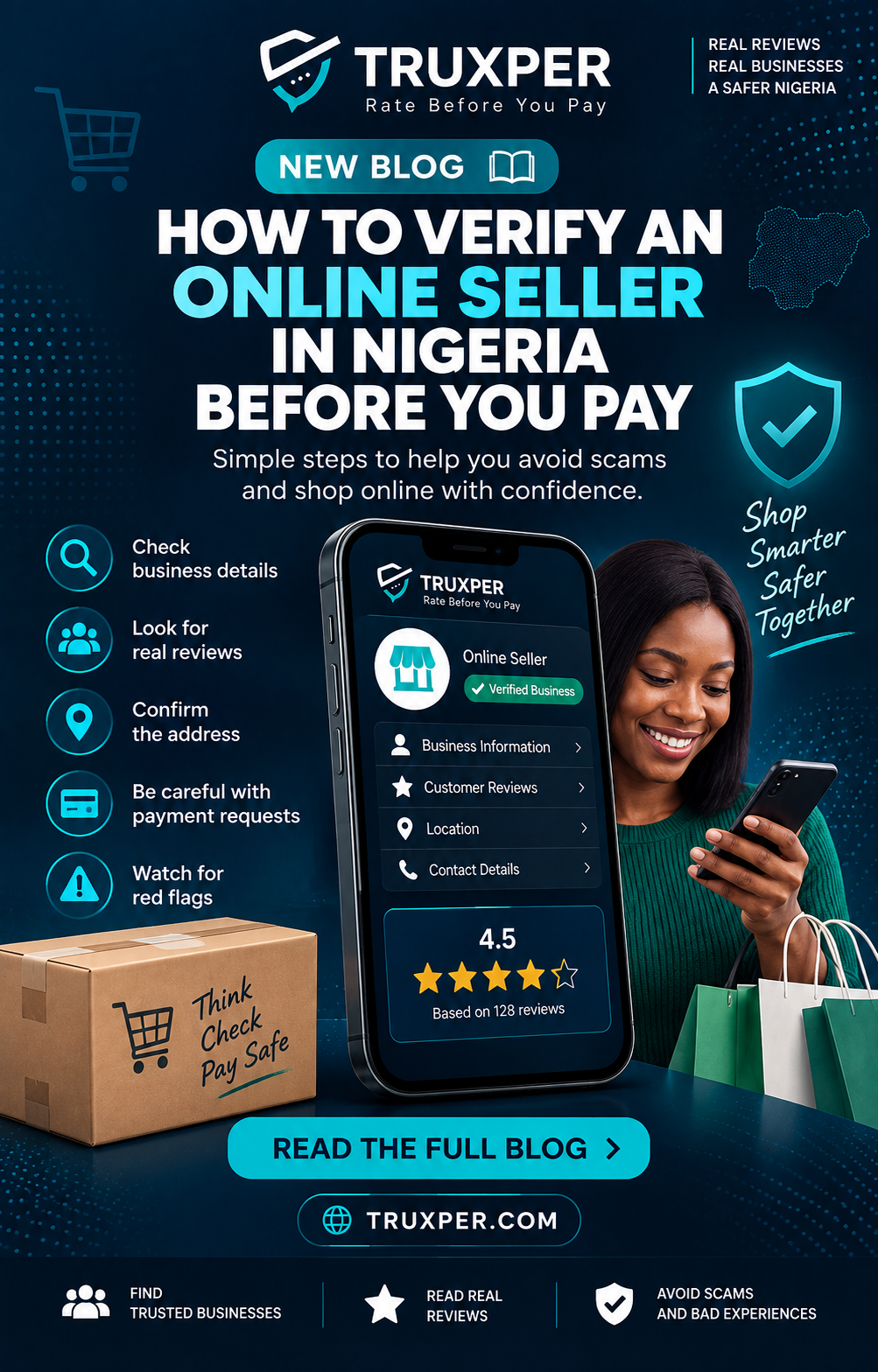
Buying from an online seller can be convenient, but sending money to the wrong person can turn a simple purchase into an expensive mistake.
From Instagram and Facebook sellers to WhatsApp businesses and online marketplaces, Nigerians increasingly buy products and services without visiting a physical shop first. Recent Visa research found that 83% of consumers surveyed in Nigeria had purchased directly through social commerce, while 57% of consumers who experienced scams said the incident happened on social media.
The good news is that you don't have to rely only on trust. You can carry out a few simple checks before making payment.
Here is how to verify an online seller in Nigeria before you pay.
1. Check the business name
Start by identifying exactly who you are dealing with.
Ask for:
- The registered business name
- Business address
- Telephone number
- Official email address
- Website, if available
- CAC registration details where applicable
A seller who refuses to provide basic business information should be treated with caution.
The Corporate Affairs Commission (CAC) maintains Nigeria's official corporate registry and provides a company search service that can be used to check registration information.
However, remember that business registration alone does not guarantee that a seller is trustworthy. It is one verification step, not the whole picture.
2. Don't rely only on social media followers
A large Instagram following does not automatically mean a business is legitimate.
Fraudsters can create professional-looking social media pages, copy photographs from genuine businesses and use fake testimonials to appear credible.
Look beyond:
- Number of followers
- Likes
- Professional-looking graphics
- Influencer endorsements
- Sponsored advertisements
Instead, look for evidence that the business has a genuine operating history.
3. Search for independent reviews
This is one of the most important checks you can make.
Don't rely exclusively on testimonials published by the seller.
Search for reviews from customers who have actually dealt with the business.
Look for patterns involving:
- Product quality
- Delivery
- Customer service
- Refunds
- Communication
- Pricing
- After-sales support
One negative review doesn't necessarily mean a business is bad. What matters is the overall pattern of customer experiences.
This is where platforms such as Truxper can help consumers research businesses and customer experiences before making a payment.
4. Verify the physical address
If a seller claims to operate from an office or shop, check whether the address appears genuine.
Look for:
- A consistent address across different platforms
- Google Maps or other location information
- Photos of the premises
- Customer references
- A business listing
Be cautious when a seller constantly changes locations or refuses to disclose where the business operates.
For expensive purchases, consider visiting the premises where practical.
5. Be careful with unusually cheap prices
A price that is dramatically lower than the normal market price deserves investigation.
For example, if a product normally sells for ₦500,000 and someone offers it for ₦200,000 with pressure to pay immediately, don't assume you have simply found a bargain.
Ask:
Why is it so cheap?
Possible explanations may be legitimate — clearance stock, used products, promotions or direct sourcing.
But an unusually low price combined with urgency, limited information and upfront payment demands is a warning sign.
6. Never let urgency replace verification
One of the oldest tricks in fraud is creating pressure.
You may hear:
"Pay now or someone else will take it."
"The price increases tonight."
"This is the last available unit."
"Send the money within 10 minutes."
Take a step back.
A legitimate seller should normally allow you reasonable time to verify what you are buying and who you are buying from.
If someone is trying to stop you from checking, that is itself a reason to check more carefully.
7. Be suspicious of payment requests that don't make sense
Pay attention to how you're being asked to pay.
Be especially careful when a seller:
- Changes bank accounts repeatedly
- Uses an account name unrelated to the business
- Requests payment to a personal account without explanation
- Sends suspicious payment links
- Requests card details through an unfamiliar website
- Asks you to send an OTP
- Claims you must pay an additional fee before receiving your refund
Never share your banking password, PIN or one-time authentication code with a seller.
8. Check the seller's history, not just one review
A single five-star review isn't enough.
A better approach is to look for a consistent history of customer experiences.
Ask:
Have other customers dealt with this business successfully?
Are complaints being resolved?
Does the business respond professionally to negative reviews?
Do customers report receiving what they paid for?
A business with hundreds of genuine customer interactions gives you more information to work with than a newly created page with a handful of perfect testimonials.
9. Keep evidence of the transaction
Before paying, save:
- Product advertisement
- Seller's profile
- Price quoted
- WhatsApp or social-media conversations
- Invoice
- Bank/payment details
- Delivery agreement
- Screenshots
- Receipts
If something goes wrong, this evidence can become important when attempting to resolve the dispute or report the transaction.
10. Know your consumer rights
Nigerian consumers have legal protections.
The Federal Competition and Consumer Protection Commission (FCCPC) states that businesses must provide factually accurate information about products and services and must not engage in misleading or deceptive representations. Its published consumer guidance also covers areas such as returns, refunds and fair dealing.
That doesn't mean every dispute will automatically result in a refund. Your circumstances and the nature of the transaction matter.
But consumers should know that they have rights and should keep evidence when something goes wrong.
A simple 5-minute verification checklist
Before sending money to an unfamiliar online seller, ask:
✓ Who exactly am I paying?
✓ Can I verify the business or seller?
✓ Does the business have a credible history?
✓ Can I find independent customer reviews?
✓ Does the physical address appear genuine?
✓ Is the price realistic?
✓ Is the payment method safe and consistent with the business?
✓ Am I being pressured to pay immediately?
✓ Have I saved the evidence of the transaction?
If several answers raise concerns, stop and investigate before paying.
Final thought: verify first, pay second
Online shopping is becoming a normal part of everyday life in Nigeria. But convenience should not mean abandoning basic checks.
A few minutes of verification can save you from hours of frustration — and potentially a significant financial loss.
Before you pay an unfamiliar business, check the business, check the reviews and check the details.
At Truxper, our philosophy is simple:
Rate Before You Pay.
Because knowing who you're dealing with is worth checking before your money leaves your account.
Comments (0)